



4 Ways Christian Teachers Can Strengthen Biblical Worldview Thinking
November 24, 2026
Katherine Schultz
A student can give a correct biblical answer without knowing how to use it.
The student may understand a doctrine during Bible class. Yet, when faced with a difficult friendship, an ethical conflict, or a cultural claim, that truth may remain disconnected from the decision at hand.
That gap matters.
Christian education seeks more than accurate recall. We want students to recognize truth, value it, and live in response to it. In other words, we want biblical truth to shape their beliefs, behaviors, and heart orientation.
However, students do not usually learn that kind of biblical reasoning through information alone. They need repeated opportunities to connect God’s Word with real questions. They also need adults who take their questions seriously and guide them toward truth.
James warns against merely listening to the Word without acting on it. “Do not merely listen to the word, and so deceive yourselves. Do what it says” (James 1:22). Biblical worldview formation involves that movement from hearing to doing.
The following four practices can help teachers make that movement more visible and intentional.
1. Discuss Real Ethical Dilemmas
Students need practice applying biblical truth before they face high-stakes decisions on their own.
A teacher might present a realistic dilemma involving academic honesty, social exclusion, artificial intelligence, entertainment choices, loyalty to a friend, or pressure to remain silent. The purpose is not to produce a quick answer. The purpose is to help students identify the beliefs and desires influencing the decision.
For example, suppose a student knows that a friend cheated but fears losing the friendship by speaking up. Several questions immediately emerge:
- What does love require?
- Does loyalty mean protecting someone from consequences?
- What responsibility does the student have to the teacher?
- What fears may be shaping the decision?
Real dilemmas help students see that moral reasoning involves more than choosing between two obvious options. They must consider what is true, what is loving, what is just, and what faithfulness requires.
Biblical morality is not created by personal preference or majority opinion. It rests in God’s character and revealed truth. Christian teachers can help students understand the source of moral knowledge rather than treating ethical choices as matters of private instinct.
At the same time, teachers should resist turning every dilemma into a disguised quiz. Students may learn to search for the response they think the teacher wants. Instead, invite them to identify assumptions, competing loyalties, possible consequences, and relevant biblical principles.
Hebrews describes mature believers as those “who by constant use have trained themselves to distinguish good from evil” (Hebrews 5:14). That phrase matters: by constant use.
Wise judgment develops through practice.
Classroom exercises can support that development, but activities alone are not enough. The deeper goal is to build habits of biblical discernment that students can carry into unfamiliar situations.
2. Teach Students to Ask, “What Does God’s Word Say?”
Students often begin ethical questions in one of four places:
What feels right to me?
What will other people think?
What will produce the easiest outcome?
What does the culture consider acceptable?
Those questions may reveal important pressures. However, they cannot serve as the final authority for a Christian.
Instead, teachers can help students develop a more basic habit: “What does God’s Word say about this?”
That question does not mean every modern issue has a verse naming it directly. Scripture does not mention every technology, platform, or school situation students will encounter. Yet, Scripture gives us the truths, commands, patterns, and priorities needed for faithful reasoning.
“Your word is a lamp for my feet, a light on my path” (Psalm 119:105). A lamp may not reveal every future turn at once. It gives enough light for faithful movement.
Teachers can model this process aloud.
- First, identify the issue clearly.
- Next, ask which biblical truths relate to it.
- Then, distinguish commands from personal preferences.
- Finally, consider how love of God and neighbor should shape the response.
Paul writes that Scripture is “useful for teaching, rebuking, correcting and training in righteousness” so that God’s servant may be equipped for every good work (2 Timothy 3:16–17). Scripture does more than supply answers. It trains people to think and live rightly.
Therefore, the teacher’s task is not simply to add a verse after students have reached a conclusion. The task is to help Scripture guide the reasoning itself.
This approach can also expose shallow proof-texting. A student may quote one verse while ignoring the larger biblical witness. Another may use a biblical phrase to defend a preferred decision. Patient questioning helps students examine whether they are submitting to Scripture or recruiting Scripture to support what they already want.
Romans 12:2 connects transformation with the renewing of the mind. Renewed thinking enables believers to “test and approve what God’s will is—his good, pleasing and perfect will.” Biblical discernment requires both truth and formation.
A useful first step is to place real worldview questions in front of your faculty or students. The free resource What Is Really Shaping Your Students? includes ten questions from the 3-D Worldview Survey. Each question can help begin discussion about beliefs, behaviors, or heart orientation.
3. Make Room for Honest Questions
Students will not reveal their real assumptions if every uncertain answer feels dangerous.
Of course, Christian schools should teach truth clearly. An open discussion environment does not require treating every belief as equally valid. Nor does it mean withholding correction.
It means creating enough relational safety for students to admit confusion, hesitation, disagreement, or doubt.
A student may wonder why Christians believe moral truth applies to everyone. Another may question whether biblical teaching can address a complex modern issue. Another may repeat cultural claims because no one has helped them examine those claims carefully.
Teachers need to know what students actually think, not only what they have learned to say.
Proverbs warns, “To answer before listening—that is folly and shame” (Proverbs 18:13). Listening does not surrender authority. It allows a teacher to respond to the student’s real question rather than an imagined one.
This is especially important when students are skeptical, defensive, or provocative. A quick rebuke may stop the conversation without changing the underlying worldview. Patient questions can reveal whether the student is confused, testing boundaries, repeating an argument, or expressing a deeper concern.
Peter instructs believers to be ready to give a reason for their hope, but to do so “with gentleness and respect” (1 Peter 3:15). Likewise, Paul tells believers to let their conversation “be always full of grace, seasoned with salt” (Colossians 4:6).
Truth and grace are not competing classroom strategies.
Teachers can preserve both by asking questions such as:
- What leads you to that conclusion?
- Which part of this issue seems hardest to reconcile with Scripture?
- What would have to be true for that argument to be sound?
- Which desire or fear might influence the way we see this?
- How would this belief shape someone’s choices?
These questions move discussion beyond debate. They help students examine the connections among belief, behavior, and heart orientation.
Honest conversation also grows from trust. Students are more likely to speak openly when teachers have demonstrated steady care in ordinary interactions. Daily mentoring provides much of the relational foundation needed for deeper worldview conversations.
Paul describes mature Christian communication as “speaking the truth in love” (Ephesians 4:15). Both parts matter. Truth without love can become harsh. Love without truth leaves students without direction.
A strong Christian classroom offers neither condemnation nor vagueness. It offers patient, truthful guidance.
4. Assess Worldview Formation Regularly
Teachers observe students constantly.
They hear classroom comments. They notice patterns in discipline. They watch how students respond to pressure, authority, conflict, worship, and service.
Those observations matter. Yet, observation alone has limits.
The most outspoken students can dominate a teacher’s impression of the class. Compliant students may conceal significant confusion. Other students may know how to give acceptable answers while holding assumptions that point in another direction.
As a result, leaders may overestimate what students understand or underestimate how deeply a cultural belief has taken root.
That is why worldview assessment should support—not replace—relationships, teaching, and observation.
Assessment gives leaders another source of information. It can reveal patterns that deserve discussion. It can also help teachers compare what students profess with reported behaviors and heart attitudes.
This distinction matters because correct answers alone do not provide a complete picture of formation.
For example, students may affirm that Scripture is authoritative while rarely consulting it when making decisions. They may believe worship matters while resenting participation. They may articulate grace clearly while relying on personal goodness for assurance of salvation.
Each response offers partial information. Together, beliefs, behaviors, and heart orientation provide a fuller picture.
The goal is not to label students or issue a spiritual report card. Instead, assessment can help leaders ask better questions:
- Where is formation strong?
- Where are students uncertain?
- Which beliefs appear disconnected from behavior?
- Which attitudes may be resisting biblical truth?
- What deserves more attention in Bible instruction, mentoring, chapel, or faculty discussion?
Philippians 1:9–10 connects growing love with knowledge and depth of insight so believers may discern what is best. Thoughtful assessment can support that kind of discernment. It gives educators information they can interpret prayerfully and carefully.
The results should then return to the classroom. Teachers can use patterns to guide discussion, refine examples, revisit misunderstood ideas, and identify areas that need patient attention.
Assessment is not the final act. It is part of an ongoing cycle:
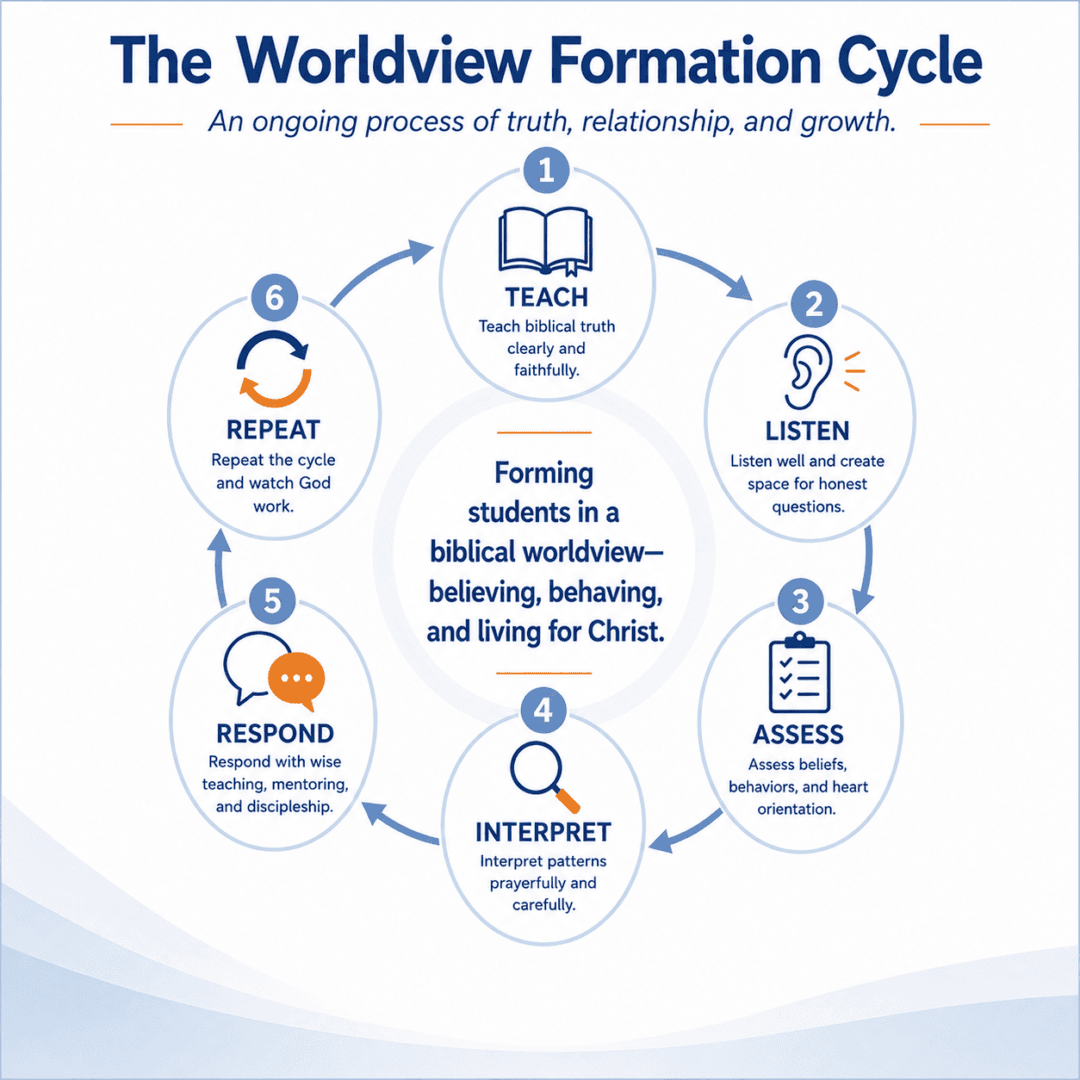
Then repeat.
Key Takeaways
- Biblical reasoning requires practice. Students need repeated opportunities to apply Scripture to real decisions, not only repeat correct ideas.
- Scripture must guide the reasoning process. “What does God’s Word say?” should shape how students define the issue, evaluate options, and choose a faithful response.
- Honest questions support deeper formation. Students are more likely to reveal confusion and hidden assumptions when teachers combine biblical clarity with patient listening.
- Assessment strengthens informed discipleship. Worldview assessment can reveal patterns across beliefs, behaviors, and heart orientation that classroom impressions may miss.
Help Students Practice Biblical Discernment
Students will face ethical questions that no teacher can predict.
They will encounter new technologies, cultural pressures, strained relationships, competing loyalties, and persuasive arguments. A list of approved answers cannot prepare them for every situation.
However, teachers can help students develop durable habits.
- They can place real dilemmas before them.
- They can teach them to begin with God’s Word.
- They can make room for honest questions.
- They can assess what is actually taking root.
These practices work together. Ethical discussion reveals reasoning. Scripture supplies authority. Honest conversation uncovers assumptions. Assessment helps leaders see broader patterns.
Together, they support worldview formation across beliefs, behaviors, and heart orientation.
The writer of Hebrews says that God’s Word is “alive and active” and that it judges “the thoughts and attitudes of the heart” (Hebrews 4:12). That is deeper than academic recall. God’s truth reaches what students think, what they love, and how they live.
Christian school leaders cannot see every influence shaping their students. Still, they do not have to rely entirely on impressions.
What Is Really Shaping Your Students? gives you ten actual survey questions to consider personally, discuss with colleagues, or use as conversation starters with a small group of students. The questions can help you notice where students respond confidently, where they hesitate, and where beliefs may not align with behaviors or heart orientation.