


What Is a Biblical Worldview in Christian Education?
January 3, 2023 (last updated September 22, 2026)
Katherine Schultz
Many Christian school leaders already care deeply about worldview formation. They invest in Bible curriculum, chapel programs, discipleship conversations, faculty mentoring, and intentional Christian culture. This is one reason many leaders continue asking why biblical worldview formation matters in Christian education beyond simply teaching Bible content.
Yet many schools still face a troubling question:
Why do some students articulate biblical truth clearly while their lives reflect something else entirely?
Students may know the right answers in Bible class. They may affirm Christian doctrine during discussions. They may even participate faithfully in Christian activities. And yet, school leaders still observe worldview confusion, moral inconsistency, shallow spiritual habits, or hidden assumptions that surface later in surprising ways.
That disconnect often reveals a deeper issue.
Many Christian schools still define worldview too narrowly.
If worldview is treated primarily as information transfer, then discipleship can quietly become centered on what students can explain rather than what is actually taking root in their lives. This creates real discipleship blind spots.
A biblical worldview certainly includes beliefs. But worldview is more than beliefs alone. It also includes behaviors and heart orientation. In other words, worldview shapes not only what students think, but also what they love, how they live, and what quietly governs their daily decisions.
That is why worldview is one of the clearest interpretive lenses for understanding spiritual formation in Christian education.
Why a Narrow Definition of Worldview Creates Problems
Many Christians naturally think of worldview as a collection of ideas or doctrines. In this understanding, worldview means believing the right things about God, truth, morality, creation, salvation, and Scripture.
Those things matter deeply. Scripture repeatedly emphasizes the importance of truth. Jesus said, “Then you will know the truth, and the truth will set you free” (John 8:32). Paul instructed believers to be “transformed by the renewing of your mind” (Romans 12:2). Christian schools should absolutely teach doctrine clearly and faithfully.
However, Scripture never treats worldview as merely intellectual.
Jesus warned that people can honor God “with their lips, but their hearts are far from me” (Matthew 15:8). James wrote that faith without action is dead (James 2:17). Proverbs 4:23 instructs believers, “Above all else, guard your heart, for everything you do flows from it.”
Biblically speaking, worldview always reaches beyond information.
This matters enormously in Christian education because schools can unintentionally measure only what is easiest to observe academically. Teachers can evaluate quizzes, essays, memory work, and classroom discussion. Those assessments matter, but they do not necessarily reveal whether biblical truth is shaping students’ habits, desires, reactions, or affections.
A student may answer theology questions correctly while still absorbing hidden worldview influences from entertainment, social media, peer culture, family habits, or broader cultural narratives.
That does not mean Christian education has failed.
But it does mean worldview formation requires deeper discernment than doctrinal recall alone.
What Worldview Actually Includes
A biblical worldview involves at least three deeply connected dimensions:
- Beliefs — what a person understands and affirms as true
- Behaviors — the habits and actions that flow from those beliefs
- Heart orientation — the desires, loves, attitudes, and worship shaping the inner life
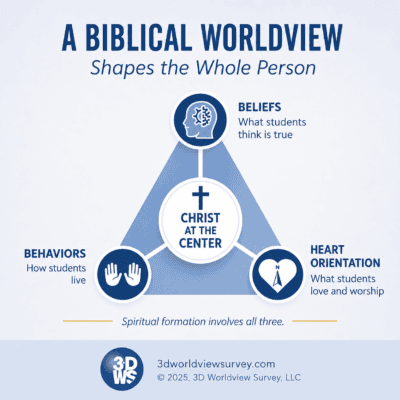
These dimensions constantly influence one another.
Students do not simply think their worldview. They live it.
That is why worldview formation cannot be reduced to information transfer alone.
James W. Sire described worldview as “a fundamental orientation of the heart.” That language matters because Scripture consistently treats the heart as central to spiritual formation. In biblical thought, the heart is not merely emotional feeling. It represents the inner core of desire, worship, motivation, affection, and allegiance.
Jesus taught, “For where your treasure is, there your heart will be also” (Matthew 6:21).
In Christian schools, this means worldview formation is not limited to:
- classroom lectures
- doctrinal statements
- apologetics units
- Bible memory
- chapel attendance
Those things are important. But worldview also forms through:
- repeated habits
- cultural practices
- peer influence
- digital consumption
- emotional loyalties
- faculty modeling
- institutional priorities
- everyday school culture
Students are always being formed.
The question is whether Christian schools are recognizing all the dimensions involved in that formation.
For many leaders, this realization raises an uncomfortable but important question: Are we evaluating worldview formation deeply enough to recognize where beliefs, behaviors, and heart orientation are aligned — and where they are not?
That is one reason reflective worldview questions can be so valuable. They often surface assumptions, inconsistencies, and hidden influences that remain invisible in ordinary classroom discussion.
Wondering what is really shaping your students? These 10 sample questions can help you look beneath the surface.
Why Behaviors Matter in Worldview Formation
Some leaders become uncomfortable when behaviors are discussed as part of worldview. They worry this could reduce Christianity to moralism or external performance.
That concern is understandable. Scripture clearly teaches that salvation is not earned through works (Ephesians 2:8–9).
However, Scripture also consistently teaches that beliefs and actions remain connected.
Jesus said, “A tree is recognized by its fruit” (Matthew 12:33). James challenged believers to demonstrate faith through action (James 2:18). Paul instructed Christians to “live a life worthy of the calling you have received” (Ephesians 4:1).
Behaviors reveal what is being normalized, practiced, reinforced, and embodied over time.
In Christian schools, worldview formation becomes visible in countless ordinary moments:
- how students respond to authority
- how they treat classmates
- how they use technology
- how they handle conflict
- how they respond to suffering
- how they speak about truth
- what they laugh at
- what they admire
- what they pursue privately
These patterns matter because habits shape people over time.
Students are not only learning worldview propositions. They are learning worldview practices.
That is why Christian schools sometimes experience what could be called out-of-balance worldview formation. A student may sincerely affirm biblical truth intellectually while simultaneously developing habits that gradually reshape desires, assumptions, and loyalties.
Over time, those habits influence what feels normal, believable, or desirable. In some cases, those patterns eventually contribute to students drifting from biblical conviction over time, even after years of Christian education.
This is one reason worldview assessment matters.
Without intentional reflection, schools can drift into relying on assumptions rather than clear insight about what is actually taking root in students’ lives.
But information exposure alone does not guarantee transformation.
As Paul wrote, “Do not conform to the pattern of this world, but be transformed by the renewing of your mind” (Romans 12:2). That transformation involves more than acquiring information. It involves the reshaping of the whole person.
Why Heart Orientation Cannot Be Ignored
Perhaps the most difficult dimension of worldview formation to recognize is heart orientation.
Schools naturally focus on what students can articulate and what faculty can observe externally. But Scripture repeatedly emphasizes the importance of inward orientation.
Proverbs 4:23 says, “Above all else, guard your heart, for everything you do flows from it.”
The heart influences:
- worship
- desires
- fears
- affections
- loyalties
- motivations
- identity
- hopes
- loves
This is one reason measuring heart orientation in Christian education is often far more complex than simply evaluating academic understanding. This dimension often explains why two students with similar theological knowledge can develop very different patterns of spiritual maturity.
One student may increasingly love truth, humility, repentance, worship, and obedience. Another may outwardly comply while quietly nurturing pride, cynicism, resentment, self-centeredness, or divided loyalties.
Christian schools see this tension regularly.
Some students appear spiritually engaged publicly but become deeply resistant when challenged personally. Others quietly develop sincere affection for Christ even before they become highly articulate about theology.
This is why worldview formation must remain connected to discipleship and spiritual formation rather than functioning merely as academic instruction.
The goal is not simply producing students who can defend Christian ideas.
The goal is helping students become people whose beliefs, behaviors, and heart orientation increasingly align with biblical truth.
That process takes time, wisdom, prayer, community, repentance, instruction, modeling, and the work of the Holy Spirit.
Christian schools cannot manufacture spiritual maturity.
But they can cultivate environments that intentionally support biblical worldview formation across all three dimensions.
Why This Matters for Christian School Leaders
Christian school leaders constantly make decisions that shape worldview formation:
- hiring faculty
- selecting curriculum
- structuring discipline
- planning chapel
- evaluating culture
- mentoring students
- addressing technology
- responding to cultural issues
- setting institutional priorities
Yet many of those decisions rely heavily on assumptions.
Leaders often hope students are developing a mature biblical worldview. But hope alone does not provide clarity.
This is one reason assessment matters in spiritual formation work.
Schools regularly assess academic growth because leaders understand the importance of knowing where students are strong and where growth is needed. Yet many schools hesitate to assess worldview formation with the same intentionality.
That hesitation is understandable. Spiritual formation is complex and deeply personal.
However, thoughtful assessment does not replace discipleship. It strengthens it.
Assessment can help leaders:
- identify worldview gaps earlier
- recognize hidden influences
- understand patterns across groups
- tailor discipleship conversations
- strengthen curriculum intentionally
- avoid relying entirely on assumptions
Most importantly, assessment can help schools move from vague concern to clearer understanding.
Related resource: “15 Key Parameters of a Biblical Worldview for Christian Educators” explores several worldview areas Christian schools often overlook in practice.
A Clearer Lens for Spiritual Formation
Christian schools have always cared about spiritual formation. The question is not whether formation matters.
The question is whether schools are recognizing the full picture of how formation actually works.
Worldview is not merely what students can explain on a theology quiz.
It includes:
- what students believe
- how students live
- what students love
- what is shaping their desires
- what influences their habits
- what quietly governs their hearts
That is why worldview must be understood three-dimensionally.
When schools reduce worldview to information transfer alone, important dimensions of discipleship can remain hidden. But when leaders begin examining beliefs, behaviors, and heart orientation together, they gain a clearer lens for understanding what is truly taking root in students’ lives.
If you want a practical starting point for reflecting on worldview across all three dimensions, the “10 Questions to Discover Your Worldview” resource can help you begin identifying areas of alignment, inconsistency, strength, and growth.
Key Takeaways
- Worldview is more than beliefs. A biblical worldview includes beliefs, behaviors, and heart orientation working together, not merely doctrinal knowledge.
- Spiritual formation cannot be reduced to information transfer. Students may articulate biblical truth while still developing habits, desires, and assumptions shaped by competing influences.
- Christian schools need clarity, not assumptions. Thoughtful worldview assessment helps leaders identify hidden formation gaps and disciple students more intentionally.
- Behaviors and heart orientation matter deeply. Scripture consistently connects truth, action, worship, affection, and inward transformation rather than separating them into isolated categories.
- Worldview provides a powerful lens for understanding discipleship. Examining beliefs, behaviors, and heart orientation together helps schools better understand what is truly taking root in students’ lives.