



The Role of Worldview in Shaping Ethical Decision Making
April 23, 2024 (Updated March 24, 2026)
Katherine Schultz
Christian school leaders often watch student behavior and draw conclusions from what they see. A student tells the truth under pressure. Another cuts corners when no one is looking. A third shows compassion one day and indifference the next. Those moments matter. Yet they do not explain themselves.
That is where many schools face a quiet problem. We can see ethical decisions, but we cannot always tell what is shaping them. We may assume a student is acting from biblical conviction when the real driver is habit, fear, social pressure, or the desire to look good. Or we may also assume a poor choice proves deep rebellion when it may reveal confusion, immaturity, or a gap between stated belief and lived understanding.
In other words, ethical decisions are visible, but worldview is interpretive. If we want to understand student formation well, we have to look beneath behavior and ask what students believe about truth, God, authority, and the moral order of the world. That is one reason Christian schools need more than good instincts. We need a clearer way to understand the beliefs, behaviors, and heart attitudes that shape what students do.
Ultimate Reality and Moral Order
Every ethical decision rests on a prior assumption about ultimate reality. Before a student decides whether honesty matters, whether justice should cost something, or whether compassion is owed to others, that student is already living from some answer to a deeper question: What is ultimately real, and who defines what is good?
A biblical worldview begins with God. “In the beginning God created the heavens and the earth” (Genesis 1:1 ). Because God is Creator, morality is not invented by the individual or negotiated by the crowd. It is grounded in the character and authority of the One who made all things. Scripture says, “The Lord is righteous in all his ways and faithful in all he does” (Psalm 145:17 ). That means right and wrong are not floating ideas. They are tied to the nature of God Himself.
This gives students a stable foundation for moral reasoning. Proverbs 3:5–6 tells us, “Trust in the Lord with all your heart and lean not on your own understanding; in all your ways submit to him, and he will make your paths straight.” Ethical clarity begins there. It begins with submission to God, not confidence in private judgment.
By contrast, when ultimate reality is treated as material, impersonal, or undefined, moral standards become unstable. Students may still speak in moral language, but they often shift their reasoning toward preference, usefulness, emotional sincerity, or social approval. That is one reason it helps to understand how schools teach comparative worldviews when students are sorting through competing claims about truth and reality.
Why Ethical Behavior Alone Can Mislead Us
Because ethical choices are observable, schools often treat them as the clearest sign of worldview formation. Certainly, behavior matters. Jesus said, “By their fruit you will recognize them” (Matthew 7:16 ). Still, fruit must be interpreted carefully. Outward behavior can reveal something real while still leaving important questions unanswered.
Two students may arrive at the same outward choice for very different reasons. One student tells the truth because he fears the Lord and believes that “The Lord detests lying lips, but he delights in people who are trustworthy” (Proverbs 12:22 ). Another tells the truth because she fears getting caught. The visible action is the same. The worldview underneath it is not.
The same is true in the opposite direction. A student may make a selfish or deceptive choice, and that choice is significant. Yet wise discipleship asks more than, “Was this wrong?” It also asks, “What beliefs, desires, or assumptions made this choice seem reasonable?” James 1:5 reminds us to ask God for wisdom, and Christian school leaders need that wisdom when responding to ethical patterns in students.
This is why teaching students about morality is not only a matter of stating rules. It is also a matter of helping them understand why moral truth is knowable at all and why it binds us. That deeper issue sits behind much of the confusion schools now face in student ethical reasoning.
A 3-D View of Ethical Decision Making
Ethical decisions do not emerge from a single source. They arise from the interaction of beliefs, behaviors, and heart orientation. That is why a 3-dimensional understanding of worldview matters so much in Christian education.
First, propositional beliefs shape what students think is true. If a student believes God is holy, truth is real, and Scripture is authoritative, those beliefs will affect moral reasoning. Psalm 119:105 says, “Your word is a lamp for my feet, a light on my path” . A student who treats God’s Word as light will not reason about ethics in quite the same way as a student who sees truth as self-generated.
Second, habitual behaviors reinforce or weaken worldview over time. Romans 12:2 calls believers not to conform to the pattern of this world but to be transformed by the renewing of the mind. Ethical choices are not isolated incidents. Repeated patterns train students toward either obedience or compromise.
Third, heart orientation directs what students love, fear, trust, and seek. Proverbs 4:23 warns, “Above all else, guard your heart, for everything you do flows from it” . Jesus likewise taught, “For the mouth speaks what the heart is full of” (Luke 6:45 ). A student may know the right answer and still choose against it because that student has attached his or her heart to some rival desire.
This is where the 3-D framework becomes especially useful. It prevents leaders from reducing worldview to ideas alone. It also prevents us from treating visible behavior as the whole story. To help you start surfacing those deeper layers, the 10 Questions to Discover Your Worldview PDF can be a helpful first step for conversations about the assumptions that often lie beneath student choices.
Heart, Habit, and the Limits of Observation
Christian schools are right to pay close attention to patterns in student conduct. Discipline, classroom participation, peer treatment, and worship posture all matter. These are visible, measurable, and often tied to culture and accountability systems.
But observation has limits. It can tell us what students are doing. It cannot always tell us why they are doing it. Behavior alone does not reveal a student’s worldview.
That distinction matters because discipleship requires precision. If a student is compliant but inwardly disengaged, leaders may overestimate formation. If a student resists in one visible area, leaders may miss important evidence of conviction or spiritual struggle elsewhere. First Samuel 16:7 reminds us that “People look at the outward appearance, but the Lord looks at the heart.” Christian educators are not omniscient, and we should be careful not to draw conclusions that behavior alone cannot support.
A student may comply externally while holding beliefs that are confused, inconsistent, or unexamined. Others may affirm correct beliefs without those beliefs shaping daily decisions. What we see is only part of the picture.
This becomes especially important in areas where external participation can mask internal distance. A student may attend chapel, follow expectations, and use the right language while remaining spiritually detached. The same pattern appears in ethical decisions. The visible action is real, but the unseen drivers still matter.
Jeremiah 17:9 cautions that “The heart is deceitful above all things and beyond cure. Who can understand it?” This does not make understanding impossible. It does require humility and care, especially when interpreting outward behavior.
Student Worldview Assessment beyond Behavior
A faithful approach to biblical worldview assessment in Christian schools requires attention to three distinct but connected dimensions: what students believe, how they behave, and the attitudes that shape both.
Here is a simple way to visualize what is often missing when schools rely on behavior alone:
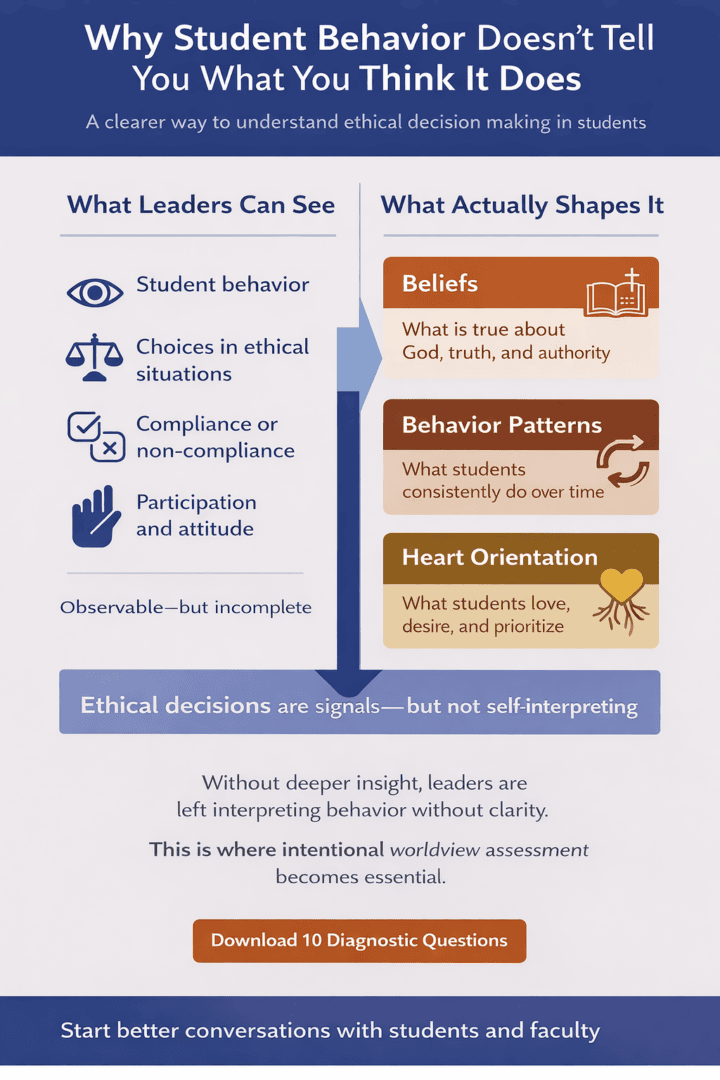
Biblical worldview formation requires attention to beliefs, behaviors, and heart-level attitudes—not just observable choices.
Considering these three dimensions together helps reveal patterns that would otherwise remain hidden. This is where assessment becomes genuinely useful for discipleship rather than merely describing surface-level compliance.
Why Assessment Strengthens Discipleship
If worldview shapes ethical decision making, and if worldview includes beliefs, behaviors, and heart orientation, then Christian schools need better tools than observation alone. Assessment cannot replace discipleship, but it can sharpen it.
A wise assessment process helps leaders move from isolated anecdotes to discernible patterns. It can reveal whether students affirm biblical truths propositionally but drift behaviorally. It can show when external practices are present while heart attitudes remain misaligned. And it can also help schools identify where formation efforts are bearing fruit and where assumptions still need careful attention.
This is one reason worldview assessment belongs inside serious Christian school leadership. Second Corinthians 13:5 says, “Examine yourselves to see whether you are in the faith; test yourselves.” Self-examination is not opposed to grace. It is part of spiritual seriousness. In a school setting, thoughtful assessment can serve that same seriousness by helping leaders ask better questions, teach more precisely, and respond more wisely.
If you want a broader framework for how schools can assess worldview maturity rather than relying on beliefs alone, it is worth considering what it means to look beyond beliefs to a fuller set of formation markers.
And if you want to understand more specifically why ultimate reality matters so much in the formation of students’ moral thinking, you may also want to revisit how that foundational category shapes everything else.
Seeing Student Decisions More Clearly
Christian school leaders cannot afford to treat ethical decisions as self-interpreting. Students make choices from somewhere. They act from what they believe, what they love, what they practice, and what they assume to be true about God and the world.
That is why the work of spiritual formation must stay connected to the 3-D worldview framework. Beliefs matter. Behaviors matter. Heart orientation matters. When those dimensions align under the authority of Scripture, students are better prepared to act with integrity. When they do not, ethical inconsistency should not surprise us.
The encouraging news is that Christian schools do not have to guess. Galatians 6:9 calls us not to become weary in doing good, and faithful leadership includes seeking wiser ways to understand the students entrusted to us. When leaders move beyond surface observation and begin asking sharper worldview questions, they are better positioned to disciple students with clarity, patience, and truth.
If this post has highlighted how much ethical decision making can reveal—and how much it can still hide—the 10 Questions to Discover Your Worldview PDF is a practical next step. It can help you begin richer conversations about the beliefs, behaviors, and attitudes that shape student moral choices.
Key Takeaways
- Ethical decisions are visible, but they are not self-explanatory. Student choices matter, but leaders still need to understand the worldview assumptions beneath those choices before drawing strong conclusions.
- Ultimate reality shapes moral reasoning. When students see God as Creator and moral authority, ethics has a stable foundation. When that foundation shifts, moral judgment often becomes unstable as well.
- Behavior alone cannot tell the whole story. The same outward action may arise from conviction, fear, habit, or approval-seeking, which is why it’s critical to pair observation with deeper discernment.
- Assessment can strengthen discipleship. Thoughtful worldview assessment helps Christian schools move from guesswork to clearer understanding of student beliefs, behaviors, and heart orientation.