



May 5, 2026
Katherine Schultz
Short-form video like TikTok disciples your students every day.
So does YouTube.
The question is not whether students are being formed. They are. The question is whether Christian schools are equipping them to evaluate what forms them.
Short-form video is now one of the dominant formative influences in adolescent life. It shapes imagination, humor, moral instincts, emotional reactions, and even spiritual assumptions. Therefore, if spiritual formation in your school stops at chapel, Bible class, or a general warning about “worldliness,” you are leaving a major arena untouched.
The issue is not platform bans. It is discernment.
And discernment must be anchored in the 3-D worldview framework: beliefs, behaviors, and heart orientation.
Why Short-Form Video Is Formative
Short-form video content works through repetition and emotional intensity. It compresses narrative into seconds. It rewards outrage, sarcasm, spectacle, and desire. Moreover, it bypasses extended reasoning and trains rapid judgment.
Scripture reminds us that formation is not neutral. Paul warns, “Do not conform to the pattern of this world, but be transformed by the renewing of your mind” (Romans 12:2). Conformity happens quietly. It happens through patterns.
Similarly, Proverbs teaches, “Above all else, guard your heart, for everything you do flows from it” (Proverbs 4:23). The heart is not merely emotion. It is the control center of belief, desire, and action.
Therefore, when students scroll endlessly through short-form content, they are not just watching. They are rehearsing patterns of thought and affection.
If you need a practical starting point for helping faculty think about worldview patterns more intentionally, download the 10 Questions PDF now. It gives you concrete language for identifying belief, behavior, and attitude misalignments.
From General Warnings to Specific Evaluation
Many Christian schools tell students to “be careful what you watch.” That is not wrong. But it is insufficient.
Students need tools.
In our post, “How to Teach Students to Evaluate Entertainment Through a Biblical Lens,” we addressed broad entertainment categories. However, TikTok and YouTube demand sharper questions because they are faster, shorter, and more immersive.
Discernment habits must be explicit and repeatable.
Evaluating Beliefs: What Is Being Claimed as True?
First, train students to identify truth claims.
Even comedy makes claims. Even dance trends communicate assumptions. Every viral clip carries a vision of reality.
Ask students:
- What does this video assume about human nature?
- What does it imply about right and wrong?
- What does it portray as normal or desirable?
Jesus said, “Sanctify them by the truth; your word is truth” (John 17:17). Therefore, truth is not subjective reaction. It is anchored in God’s revealed Word.
Additionally, Scripture tells us that “The fear of the Lord is the beginning of knowledge” (Proverbs 1:7). Evaluation must begin with reverence, not trend awareness.
Students should learn to compare implicit claims with biblical teaching. For example:
If a clip mocks authority, how does that align with “Submit yourselves for the Lord’s sake to every human authority” (1 Peter 2:13)?
If a video glorifies self-expression above all else, how does that relate to “You are not your own; you were bought at a price” (1 Corinthians 6:19–20)?
This is not about moral panic. It is about intellectual honesty.
Evaluating Behaviors: What Is Being Normalized?
Before we move further, it helps to see how these patterns work together:
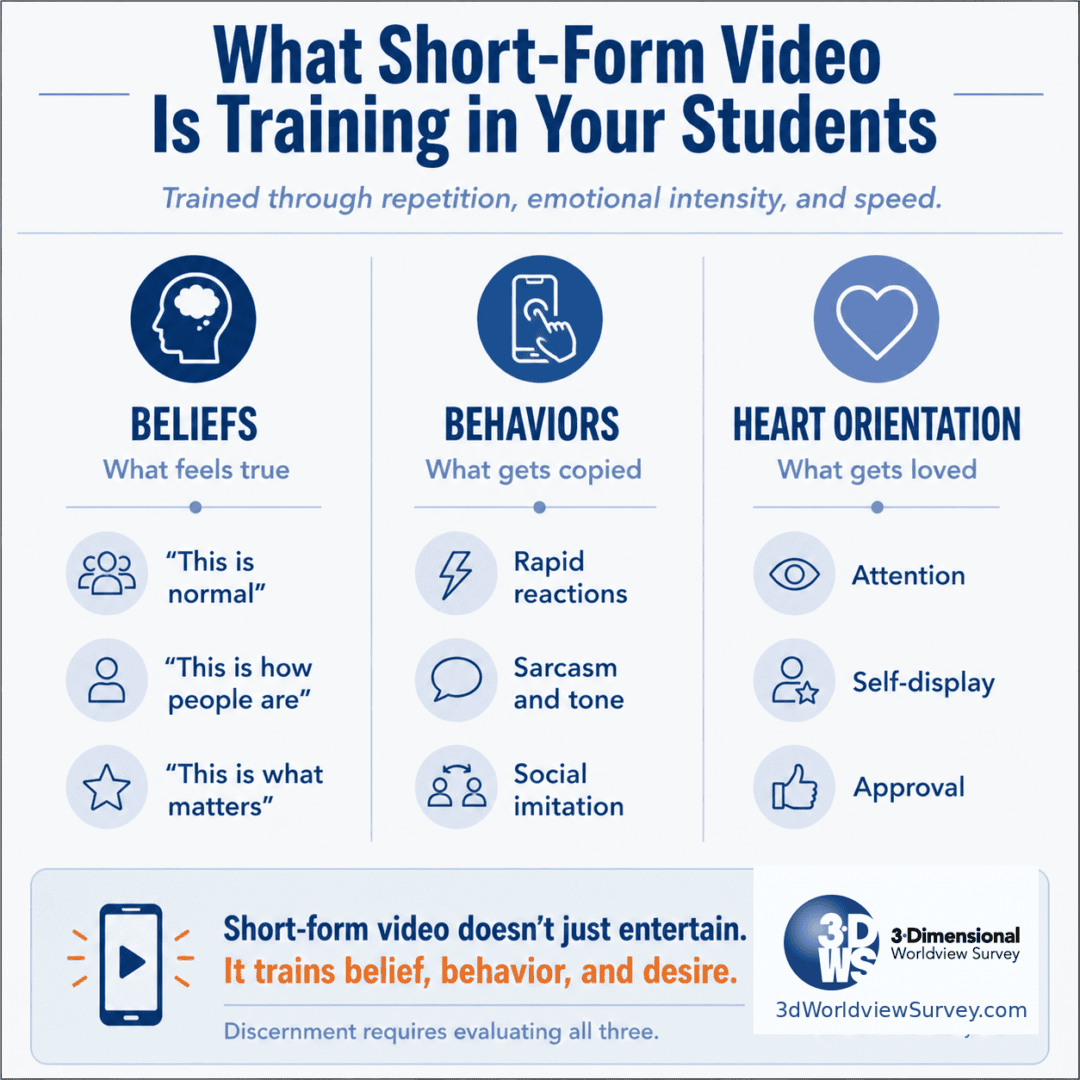
Second, address behavior.
Short-form video trains imitation. Students copy language, gestures, humor, and even relational patterns. “Bad company corrupts good character” (1 Corinthians 15:33) applies digitally as much as physically.
Moreover, James writes, “Do not merely listen to the word, and so deceive yourselves. Do what it says” (James 1:22). Discipleship requires embodied obedience.
Ask students:
- Does this content encourage conduct that reflects Christ?
- Does it shape habits I would defend publicly?
- Would I be comfortable if my younger sibling copied this?
Philippians 4:8 gives a practical grid: “Whatever is true, whatever is noble, whatever is right, whatever is pure, whatever is lovely, whatever is admirable… think about such things.” Notice that Paul does not command withdrawal from thought. He commands disciplined thought.
Therefore, help students articulate why certain behaviors align—or do not align—with biblical patterns.
Evaluating Heart Orientation: What Is Being Loved?
Third, examine the heart.
Heart orientation is the most overlooked dimension. Yet it is the most decisive.
Jesus teaches, “For where your treasure is, there your heart will be also” (Matthew 6:21). Repeated exposure trains treasure. It trains desire.
Similarly, Psalm 1 contrasts delight in the law of the Lord with delight in the counsel of the wicked. The blessed person “delights in the law of the Lord” (Psalm 1:2). Delight is not mere compliance. It is affection.
Ask students:
- What emotions does this video train me to celebrate?
- Does it cultivate gratitude or envy?
- Does it encourage humility or self-display?
Short-form video often rewards self-exaltation. Yet Scripture teaches, “God opposes the proud but shows favor to the humble” (James 4:6).
Therefore, evaluation must move beyond “Is this allowed?” to “What is this teaching my heart to love?”
Building Discernment Habits in School Life
Discernment cannot be a one-time assembly talk.
It must be practiced.
Here are three school-based applications:
- Classroom Analysis Moments
Dedicate brief segments to analyzing trending content categories. Do not show questionable clips. Instead, describe common patterns and evaluate them through Scripture. Model calm, thoughtful reasoning. - Faculty Alignment
Ensure teachers share a common language about belief, behavior, and heart orientation. When worldview language appears in science, literature, or history, students learn that evaluation is integrated, not compartmentalized. - Parent Partnership
Equip parents with the same evaluation framework. Many parents feel overwhelmed. Provide them with guiding questions rather than lists of banned apps.
Deuteronomy 6:6–7 reminds us to impress God’s commands on children “when you sit at home and when you walk along the road.” In today’s context, that includes digital roads.
Discernment is ordinary faithfulness, practiced repeatedly.
From Platform Control to Formation Leadership
You may still choose to restrict certain platforms in your school. That is a prudential decision. However, restriction alone does not produce maturity.
Hebrews 5:14 describes mature believers as those “who by constant use have trained themselves to distinguish good from evil.” Constant use. Training. Distinguishing.
That language aligns closely with the 3-D worldview model.
Beliefs must be clarified.
Behaviors must be practiced.
Heart orientation must be shaped.
Therefore, Christian school leaders must see TikTok and YouTube not merely as distractions, but as rival formative systems. And rival systems require intentional counter-formation.
Key Takeaways
- Discernment must address beliefs. Short-form video communicates implicit truth claims that students must learn to identify and compare with Scripture.
- Behavior imitation is powerful. TikTok and YouTube normalize patterns that shape conduct long before students consciously reflect on them.
- Heart orientation is decisive. The deepest formation occurs at the level of desire, not mere rule-following.
- Christian schools must move from platform reaction to worldview formation. The 3-D framework provides a coherent structure for doing so consistently and calmly.
Teaching Students to Scroll with Discernment
Students will scroll.
The question is whether they will scroll uncritically or discerningly.
Spiritual formation in a digital age requires more than rules. It requires equipping students to think biblically, act faithfully, and love rightly.
As leaders, you carry responsibility not only for curriculum, but for culture. Therefore, anchoring digital evaluation in the 3-D worldview framework ensures that belief, behavior, and heart orientation remain central.
When students learn to evaluate truth claims, resist unhealthy imitation, and examine their affections, they are practicing mature discipleship.
That is not fear-driven leadership. It is faithful formation.
If you want a simple tool to begin clarifying worldview patterns with your faculty, download the 10 Questions PDF now. It provides concrete prompts that surface belief assumptions, behavioral tendencies, and heart attitudes—before those patterns harden.