



Is the Devil a Symbol? Why This Question Matters for Spiritual Formation
June 20, 2023 (Last updated May 12, 2026)
Katherine Schultz
When Evil Becomes Ironic
You rarely hear students deny Satan outright.
Instead, you hear something subtler. A joke. A meme. A Halloween costume. A comment about “my inner demon.” The language is ironic, not hostile.
Then the survey response appears:
“The devil is a symbol of evil rather than a living being.”
At first glance, this feels like a secondary doctrine. But it is not secondary. It is structural.
Because when evil becomes metaphor, spiritual formation shifts.
Peter did not warn believers about a literary device. He wrote, “Your enemy the devil prowls around like a roaring lion looking for someone to devour” (1 Peter 5:8). That assumes agency. It assumes intent. It assumes danger.
If students quietly assume that Satan is symbolic, deception becomes psychological rather than spiritual. Temptation becomes internal impulse rather than contested resistance. Vigilance softens.
And that reshapes worldview formation across all three dimensions: beliefs, behaviors, and heart orientation, and these dimensions work together.
Scripture Does Not Treat Satan as Symbol
The biblical witness is consistent.
In Genesis 3, the serpent speaks and deceives (Genesis 3:1–5). In Job 1:6–7, Satan presents himself before the Lord. Jesus calls him “a murderer from the beginning” and “the father of lies” (John 8:44). Paul describes him as “the god of this age” who “has blinded the minds of unbelievers” (2 Corinthians 4:4).
James adds that even demons “believe that there is one God… and shudder” (James 2:19). They respond. They are not abstractions.
Even Christ’s ministry assumes a real adversary. He was tempted directly in the wilderness (Matthew 4:1–11). He told Peter, “Get behind me, Satan!” (Matthew 16:23). He acknowledged that “the prince of this world” was coming (John 14:30).
Scripture does not flatten this into metaphor.
If students reinterpret Satan as symbol, they are reframing the drama of redemption itself.
This is similar to the confusion that arises when students ask whether the Holy Spirit is merely symbolic rather than personal.
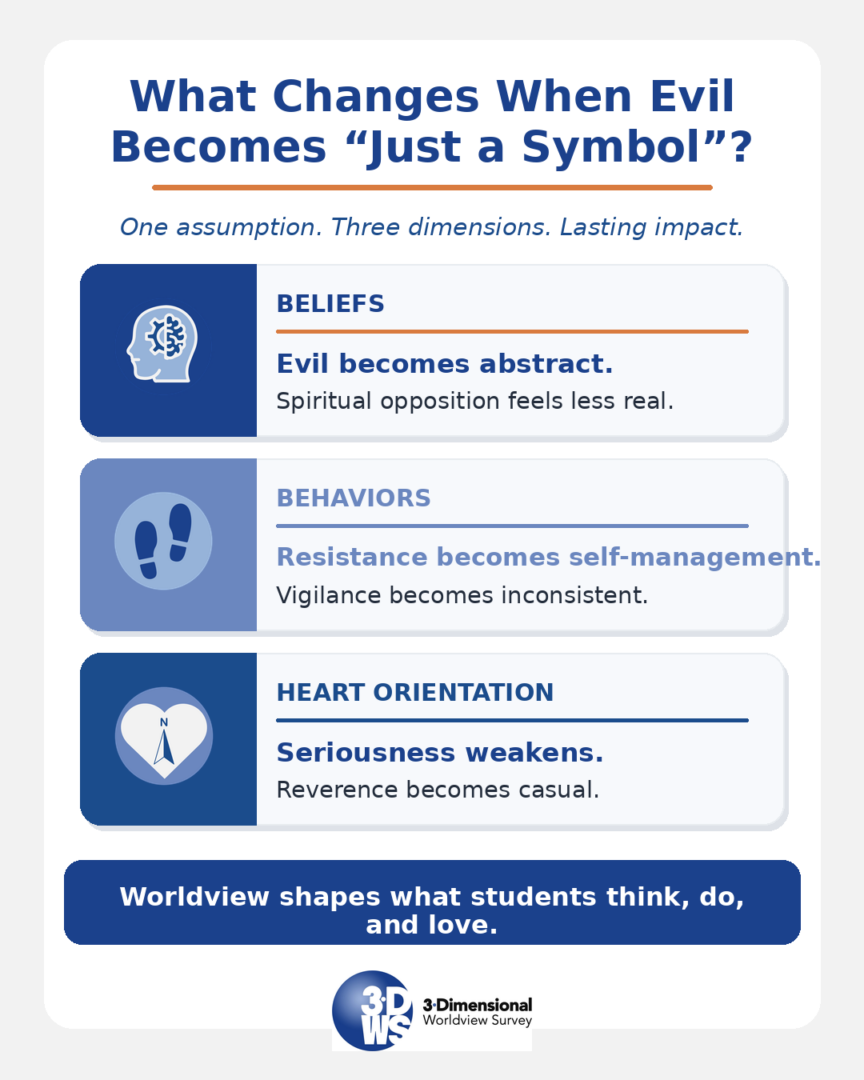
This directly affects ethical reasoning, because beliefs about reality determine how students interpret moral conflict.
If evil is metaphor, obedience becomes optional self-expression rather than meaningful resistance.
Cultural Trivialization and the Loss of Seriousness
Our culture rarely denies evil. It trivializes it.
Cartoons soften demons. Entertainment humanizes darkness. Social media filters everything through irony.
But Scripture does not trivialize.
Hebrews tells us that through His death, Christ destroyed “him who holds the power of death—that is, the devil” (Hebrews 2:14). Revelation 20:10 describes his final defeat. Romans promises, “The God of peace will soon crush Satan under your feet” (Romans 16:20).
Victory only carries weight if the adversary is real.
When students absorb cultural trivialization, they do not usually abandon faith. Instead, they domesticate it. The unseen realm becomes decorative rather than consequential. Because worldview formation requires intentional clarity.
Leadership Implications for Christian Schools
This is not a call for sensationalism. Christian schools do not need fear-based rhetoric. They need coherence.
First, belief must align with practice. If faculty affirm Satan’s reality but teach as though temptation is purely psychological, students notice.
Second, formation must connect belief to behavior. Jesus told His disciples, “I have given you authority… to overcome all the power of the enemy” (Luke 10:19). Authority presupposes opposition.
Third, heart orientation must be cultivated deliberately. Proverbs says, “The fear of the Lord is the beginning of wisdom” (Proverbs 9:10). When evil becomes symbolic, reverence often softens into comfort.
Seriousness and affection are not enemies. In fact, reverence deepens love rather than diminishing it.
Likewise, everyday practices reinforce worldview assumptions, and small habits either strengthen or erode theological clarity.
Why This Question Still Matters
The 3-Dimensional Worldview Survey includes a question about the devil as real or symbolic.
This is not a curiosity question. It is diagnostic.
It reveals how students interpret unseen reality. It signals whether they treat evil as metaphor or adversary. It surfaces whether their worldview framework aligns with Scripture’s.
If you want a simple way to begin reflecting on worldview assumptions like this with your team, download the 10 Questions PDF and use it in faculty discussion.
Reality, Redemption, and Formation
The Christian story begins with conflict in Genesis 3 and ends with final victory in Revelation 20. In between, believers are called to stand firm, resist, and trust.
If Satan is merely symbolic, the battle feels theatrical. If he is real, obedience carries weight.
Spiritual formation in Christian schools must integrate:
Beliefs that align with Scripture.
Behaviors that reflect vigilance and obedience.
Heart orientation marked by seriousness and hope.
When those three dimensions align, students grow not only in knowledge, but in resilience.
Key Takeaways
- Symbolic thinking reshapes spiritual seriousness. When Satan becomes metaphor, vigilance declines and moral agency shifts.
- Worldview assumptions affect behavior. Beliefs about unseen reality directly influence resistance, obedience, and ethical decision-making.
- Spiritual formation requires coherence. Christian schools must align belief, practice, and heart orientation around the full biblical narrative—including the reality of spiritual opposition.
If this topic surfaces deeper questions about how your students interpret spiritual reality, the 10 Questions PDF is a practical starting point.