


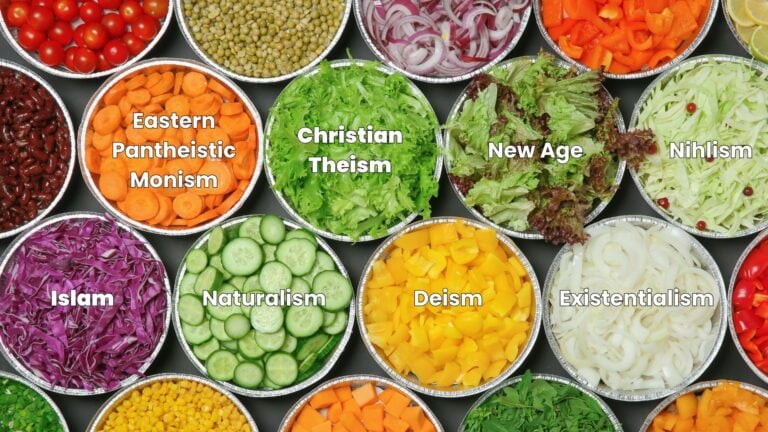
Meta-Modern Confusion: Why Students Borrow Truth from Everywhere
April 28, 2026
Many Christian school leaders still reach for the word “postmodern” to explain what they see in students: relativism, skepticism, identity-as-self-definition, and discomfort with authority.
Some of that language still fits. But it increasingly fails to explain a pattern leaders are noticing more often:
Students borrowing “truth” from everywhere—without feeling the contradictions.
One day a student sounds theologically serious, even orthodox. The next day they interpret life through a therapeutic script. Another day they borrow moral language from activism, and another day they drift into irony and detachment.
The issue is not simply that students deny truth.
Often, they sample it.
And that sampling posture is better described today as meta-modern.
If you want a practical way to begin spotting this pattern in your students without jumping to labels, the resource “10 Questions Every Christian School Leader Should Be Asking About Student Worldview” can serve as an initial diagnostic lens—especially because it forces clarity across beliefs, behaviors, and heart orientation rather than only asking what students can affirm out loud.
What Meta-Modernism Is (In This Post)
Meta-modernism is often discussed as a cultural shift “after postmodernism,” but this post is not a technical survey of philosophy.
For Christian school leaders, meta-modernism is most useful to understand as a posture:
A pattern of oscillation, mixing, and selective borrowing that resists stable integration.
In other words, meta-modernism is not primarily a system students consciously adopt.
It is a way of moving through competing truth-claims without settling the conflicts.
What Meta-Modernism Is Not
To keep category clarity, it helps to name boundaries.
Meta-modernism is not:
- A coherent worldview system students can neatly articulate
- The same thing as postmodernism
- Simple rebellion or simple ignorance
- A uniquely teen phenomenon (though teens express it vividly)
If your leadership team still needs a shared baseline for what “worldview” means before you can parse newer terms like meta-modern, revisit a basic definition first.
Why “Postmodern” Language No Longer Suffices
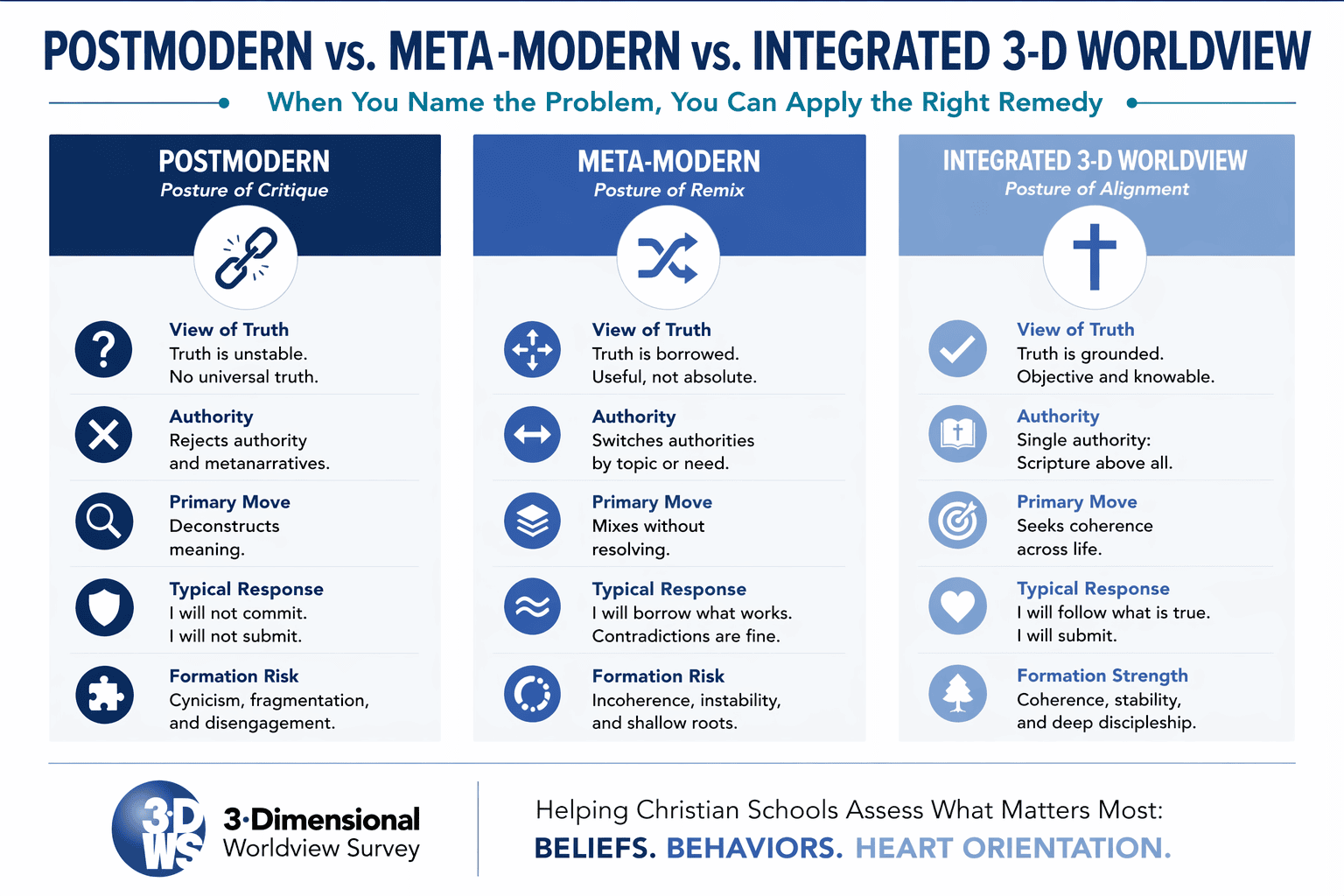
Postmodernism classically emphasized deconstruction: suspicion of metanarratives, rejection of universal claims, and destabilizing the idea of objective truth.
Many leaders learned to interpret students through that lens. And it still captures something real.
But here is the shift leaders are encountering:
- Postmodernism tends to say, “Truth is unstable, so I will not commit.”
Meta-modernism tends to say, “I will borrow from multiple truth-claims as needed, and I will not worry about resolving the contradictions.” - Postmodernism is often a posture of critique.
Meta-modernism is often a posture of remix. - Postmodernism rejects coherence.
Meta-modernism wants coherence feelings, without coherence costs.
That “coherence cost” matters for discipleship. Because Christian formation is not only about preferred ideas; it is about allegiance.
Meta-Modernism as Oscillation
One of the most recognizable features of meta-modern posture is oscillation between paired impulses:
- Sincerity and irony
- Hope and cynicism
- Conviction and detachment
- Faith language and skepticism habits
Students may be earnest in one moment and dismissive the next. Not because they are trying to be inconsistent—but because they have not been trained to perceive incoherence as a problem.
It may help to frame the issue this way:
Meta-modern confusion is not simply wrong beliefs.
It is unstable integration.
And that pushes the problem directly into the 3-Dimensional framework.
Why This Is a 3-Dimensional Worldview Problem
Worldview formation is not only about what students say they believe. It includes at least three dimensions:
- Beliefs: what students affirm to be true
- Behaviors: what students actually practice and normalize
- Heart orientation: what students love, trust, and move toward over time
Meta-modern fragmentation often looks like:
- Beliefs: “I believe Christianity is true” (sometimes sincerely)
- Behaviors: shaped by competing scripts (self-sovereignty, image curation, desire management, conflict avoidance)
- Heart orientation: slowly drawn toward what rewards them—approval, comfort, autonomy, aesthetic identity, belonging
When leaders only measure beliefs, they often miss the deeper drift. When leaders measure all three, the contradictions become more visible and more addressable.
If you want language for identifying heart orientation patterns (without turning everything into psychology), this post gives a clean entry point.
Fragmented Beliefs vs. Borrowed Authorities
Meta-modern students often borrow not only ideas, but authorities.
They may treat:
- The Bible as authority for “spiritual” questions
- The self as authority for identity questions
- Peer consensus as authority for moral pressure points
- Therapeutic categories as authority for interpreting hardship
- Cultural outrage cycles as authority for justice language
This is why contradictions do not feel contradictory: the student is not living under one authority.
They are switching authorities by topic.
That is not merely intellectual confusion. It is discipleship confusion.
And it is one reason leaders can observe students who can answer doctrinal questions correctly while still making moral decisions from a different foundation.
Category Clarity for Leadership Teams
Here is a simplified distinction that helps leadership teams avoid sloppy use of terms:
- Postmodern tendency: “Truth claims are suspect; I won’t submit.”
Meta-modern tendency: “Truth claims are tools; I’ll borrow what works.” - Postmodern tendency: deconstruct systems
Meta-modern tendency: mix systems - Postmodern tendency: critique meaning
Meta-modern tendency: crave meaning while resisting constraint
This is not a complete taxonomy. It is a practical leadership distinction.
And it changes what you do next.
What Leaders Misdiagnose (And Why It Matters)
If you assume students are primarily postmodern, you may respond by:
- Increasing apologetics content
- Strengthening arguments for objective truth
- Trying to “prove” Christianity over competing claims
Those approaches can be valuable—but they are not sufficient for meta-modern fragmentation, because the issue is often not argument-level disagreement.
It is integration-level incoherence.
In a meta-modern posture, a student may agree with your argument and still live by a competing script.
That is why the problem is not solved by winning debates.
It is addressed by forming coherence across beliefs, behaviors, and heart orientation.
You want a framework for assessing whether your worldview instruction is actually producing integrated change.
What To Do (Without Sprawl)
This post is diagnostic, not programmatic. But leaders do need a few clear next moves.
Here are three leadership-level actions that match the category:
- Teach students to identify competing authorities
Not just “what do you believe?” but “who gets to decide?” and “what gets to name reality?” - Train students to spot incompatibilities
Help them practice noticing where borrowed scripts contradict biblical anthropology, biblical authority, and the lordship of Christ. - Measure formation across all three dimensions
If you only measure beliefs, you will miss the drift. If you measure beliefs, behaviors, and heart orientation over time, you will begin to see patterns.
Because heart orientation is formed through embodied rhythms, not merely ideas.
A Quick Discernment Question for Your Leadership Team
When you see contradictions in students, ask:
Is this a belief problem, a behavior problem, or a heart-orientation problem?
Often the most revealing answer is: “All three are misaligned.”
And that is exactly what meta-modern borrowing produces: partial truths without integrated allegiance.
Try to begin noticing these patterns in your student body (without guessing).
Why Precision Protects Trust
Meta-modernism is not a new creed.
It is a posture of oscillation—borrowing meaning without submitting to a single authority, and mixing truth-claims without reconciling their contradictions.
Christian school leaders do not need trend-chasing vocabulary.
They need category clarity.
Because when you misname the problem, you misapply the remedy.
If you want a simple starting tool to help your leadership team begin diagnosing student worldview patterns with clarity across beliefs, behaviors, and heart orientation, use the resource “10 Questions Every Christian School Leader Should Be Asking About Student Worldview.”
It is not a label-maker. It is a clarity tool.
Meta-modern confusion is not primarily a belief deficit; it is an integration deficit.