


Will Your Students Still Worship After Graduation?
August 4, 2026
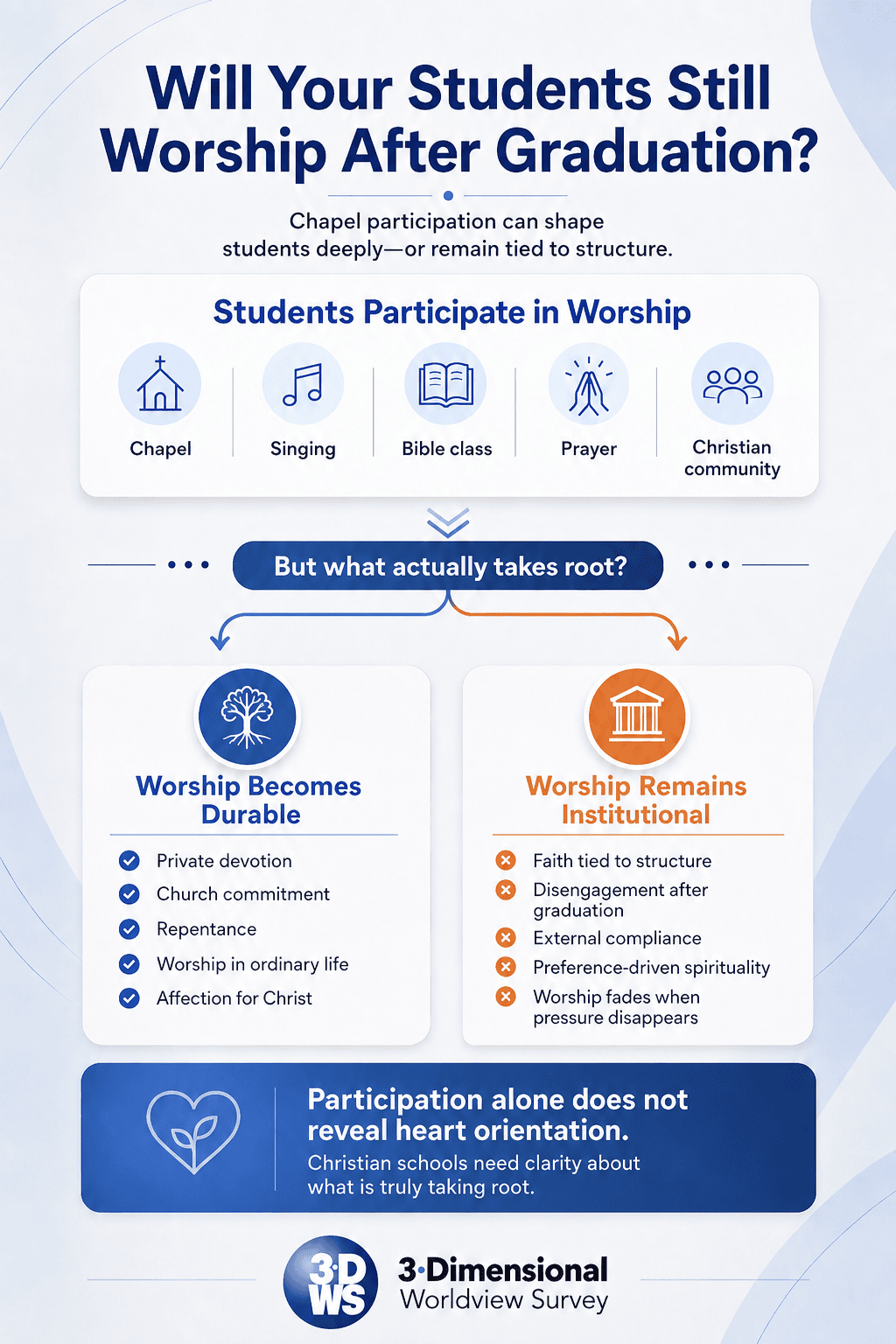
Many Christian schools invest enormous effort into worship experiences. Chapel services are carefully planned. Music teams rehearse. Speakers prepare messages. Faculty pray that students will encounter Christ in meaningful ways.
And yet, many school leaders quietly wonder something difficult:
What happens after graduation?
Do students carry those rhythms of worship into adulthood? Or do chapel experiences remain largely tied to institutional structure, fading once attendance is no longer required?
That question matters because worship is never merely an event. Scripture consistently presents worship as a formative pattern shaping the whole person. Romans 12:1 (NIV) calls believers to “offer your bodies as a living sacrifice, holy and pleasing to God—this is your true and proper worship.” Worship extends far beyond a weekly gathering. It shapes beliefs, behaviors, and heart orientation.
In other words, worship is deeply connected to worldview formation.
Christian schools sometimes assume that meaningful chapel experiences automatically produce durable spiritual habits. Sometimes they do. But not always. Students may participate sincerely in corporate worship while never developing personal affection for Christ that persists beyond structured school life.
That gap deserves attention.
Worship Can Become Institutional Instead of Personal
Students often learn how to function inside Christian environments before they develop mature personal devotion.
They know when to stand. They know worship vocabulary. They know expected emotional responses. They know how chapel “works.”
But familiarity with worship culture is not identical to affection for Christ.
Jesus warned about this tension directly when He quoted Isaiah: “These people honor me with their lips, but their hearts are far from me” (Matthew 15:8). External participation can coexist with inward distance.
This is why the 3-D worldview framework matters so much. Beliefs alone never tell the full story. A student may affirm orthodox theology while behaviors and heart orientation reveal something very different.
For example, a student may:
- Participate enthusiastically during chapel
- Speak positively about worship music
- Memorize Scripture accurately
- Yet rarely seek God privately
- Resist church involvement outside required settings
- View worship primarily as emotional experience rather than surrender
That distinction matters because lifelong discipleship depends on more than institutional participation.
Students Learn What Worship Means From School Culture
Students are always interpreting worship through the broader culture of the school.
They notice:
- Whether faculty worship sincerely or merely professionally
- Whether prayer feels authentic or performative
- Whether Scripture shapes decisions outside chapel
- Whether worship influences relationships, discipline, leadership, and conflict
In Deuteronomy 6:6–7, God instructed His people: “These commandments that I give you today are to be on your hearts. Impress them on your children.” Formation was never intended to happen only during designated religious moments. It was woven throughout daily life.
The same principle applies inside Christian schools.
Students develop their understanding of worship not only through chapel services, but also through:
- Faculty meeting culture
- Classroom tone
- Conflict resolution
- Athletic conduct
- Hallway conversations
- Responses to disappointment
- Leadership humility
- The school’s treatment of difficult students
Worship becomes believable when students see consistency between proclaimed beliefs and lived behavior.
When worship remains compartmentalized, students may subconsciously conclude that devotion belongs primarily inside formal Christian settings. That creates vulnerability later when those structures disappear.
Durable Worship Requires Habits, Not Just Experiences
Emotional experiences can be meaningful. Scripture contains many examples of emotional worship responses. David danced before the Lord (2 Samuel 6:14). The Psalms express grief, joy, fear, repentance, and celebration openly before God.
But Scripture also consistently emphasizes endurance and abiding.
Jesus said, “If you remain in me and I in you, you will bear much fruit” (John 15:5). Lifelong worship grows through ongoing attachment to Christ, not isolated emotional highs.
Christian schools sometimes unintentionally train students to associate worship primarily with:
- Large-group emotional moments
- Music-driven environments
- Retreat experiences
- Inspirational speakers
Those experiences may serve students well temporarily. However, mature discipleship eventually requires quieter forms of faithfulness:
- Prayer when emotions feel absent
- Scripture reading without external accountability
- Church involvement without social pressure
- Obedience during suffering
- Repentance after failure
- Gratitude during ordinary routines
These habits shape long-term heart orientation.
That is why worship formation must move beyond event planning into discipleship practices embedded throughout school culture.
James 1:22 warns believers to “not merely listen to the word, and so deceive yourselves. Do what it says.” Worship matures when students repeatedly connect belief, action, and affection.
Christian Schools Should Examine What Students Actually Desire
One of the most revealing worldview questions is not whether students attend worship activities.
The deeper question is whether they desire Christ Himself.
Psalm 42:1 says, “As the deer pants for streams of water, so my soul pants for you, my God” (NIV). Scripture repeatedly describes worship in terms of longing, delight, affection, and pursuit.
That language matters.
Students may comply externally while inwardly viewing worship as obligation, social expectation, or institutional performance.
School leaders often see warning signs:
- Students disengage quickly when external structures disappear
- Church involvement collapses after graduation
- Worship becomes entirely preference-driven
- Faith remains intellectually affirmed but emotionally distant
These patterns rarely emerge suddenly in college. They often develop gradually over years.
This is where worldview assessment can become extremely valuable. Schools already assess academics because leaders know assumptions can be misleading. Yet many schools still rely primarily on observation and intuition when evaluating spiritual formation.
Questions connected to heart orientation often surface realities that remain invisible during ordinary school routines.
For example: “I look forward to being away from home so I can take a break from church.”
That question does not merely measure attendance habits. It helps reveal affection, desire, and inward orientation toward worship and Christian community.
If you want to explore the kinds of worldview questions that can help surface these hidden formation patterns, download “What Is Really Shaping Your Students?” It includes 10 actual sample questions used to examine beliefs, behaviors, and heart orientation in Christian students.
Worship Formation Must Include the Ordinary
Colossians 3:17 says, “And whatever you do, whether in word or deed, do it all in the name of the Lord Jesus” (NIV).
That verse expands worship into daily life.
Students need help seeing:
- Homework as worship
- Integrity as worship
- Service as worship
- Repentance as worship
- Hospitality as worship
- Excellence as worship
- Humility as worship
Otherwise, worship risks remaining disconnected from ordinary life.
This does not diminish chapel. Corporate worship remains deeply important. Hebrews 10:25 urges believers not to neglect meeting together. Schools should continue cultivating meaningful communal worship rhythms.
But chapel should function as reinforcement and reorientation—not the sole location of worship formation.
Students need repeated help translating worship into everyday obedience.
That includes:
- Faculty modeling repentance publicly when appropriate
- Classroom conversations about faithfulness in ordinary decisions
- Discussions about how worship shapes relationships and vocation
- Reflection on how gratitude influences daily habits
- Honest conversations about spiritual dryness and perseverance
These practices help students see worship as an entire way of life.
Helping Students Carry Worship Beyond Graduation
Christian schools cannot guarantee lifelong faithfulness.
But they can help cultivate patterns that support durable affection for Christ long after structured chapel attendance ends.
That work involves more than creating meaningful worship experiences. It involves helping students connect worship to ordinary obedience, private devotion, repentance, church commitment, and daily dependence on Christ.
Because students may participate sincerely in chapel while still developing assumptions that weaken long-term spiritual endurance.
And those assumptions are often difficult to see through observation alone.
This is why many Christian school leaders eventually realize they need more than impressions, participation levels, or visible enthusiasm. They need clearer insight into whether beliefs, behaviors, and heart orientation are actually aligning beneath the surface.
If you want a practical starting point for examining what may truly be shaping your students, download “What Is Really Shaping Your Students?” These 10 sample worldview questions are designed to help leaders identify hidden formation patterns that may otherwise remain invisible until after graduation.
Key Takeaways
- Worship is larger than chapel. Scripture consistently presents worship as a whole-life orientation involving beliefs, behaviors, and heart affection toward Christ.
- Students learn worship from culture as much as programming. Faculty behavior, school relationships, leadership decisions, and ordinary routines all shape students’ understanding of worship.
- Emotional experiences alone do not create durable faith. Lifelong affection for Christ develops through repeated habits of obedience, repentance, Scripture engagement, and perseverance.
- Heart orientation matters deeply. Students may participate externally in worship while remaining internally disengaged from Christ Himself.
- Christian schools need clarity, not assumptions. Worldview assessment can help leaders identify whether worship formation is taking root beneath visible participation.