


Why Do Students Say the Right Things but Live Differently?
June 23, 2026
Katherine Schultz
A student gives an excellent answer in Bible class.
He explains salvation by grace. He identifies key biblical doctrines. He can articulate what a Christian should believe about God, truth, and morality. Later that same day, his choices tell a different story.
Most Christian school leaders have seen this tension.
Students often know more than they live. They can articulate biblical truth yet struggle to embody it consistently in daily life. That raises a difficult question: How do you know whether this disconnect is limited to a few students—or whether it reflects a broader pattern across your school?
More importantly, how do you identify those gaps before students graduate?
Knowledge Is Not the Same as Formation
Christian schools rightly place significant emphasis on biblical truth.
After all, Scripture repeatedly calls believers to know God’s Word. Paul instructed Timothy to continue in what he had learned (2 Timothy 3:14-15). Jesus prayed, “Sanctify them by the truth; your word is truth” (John 17:17).
Knowledge matters. Yet Scripture also reminds us that knowledge alone is insufficient. James asks a penetrating question: “Do not merely listen to the word, and so deceive yourselves. Do what it says” (James 1:22).
That distinction matters for Christian education.
Students may understand biblical concepts without allowing those concepts to shape daily decisions. They may affirm truth intellectually while struggling to apply it relationally, morally, or spiritually.
Students may understand biblical concepts without allowing those concepts to shape daily decisions. They may affirm truth intellectually while struggling to apply it relationally, morally, or spiritually.
Correct answers alone do not reveal whether worldview formation is actually taking root.
The challenge is not usually a lack of teaching. The challenge is determining whether that teaching is producing lasting transformation.
Many leaders find it helpful to begin by examining a few carefully selected worldview questions. The free guide, “What Is Really Shaping Your Students?” includes ten actual survey questions that can help surface areas where students’ beliefs, behaviors, and heart orientation may not fully align.
Looking Beyond a Simple Belief-Behavior Gap
Many leaders describe the challenge as a gap between belief and behavior.
Students know what is true, yet their actions do not always reflect that knowledge.
That observation is often accurate. Yet it can also oversimplify what is happening beneath the surface.
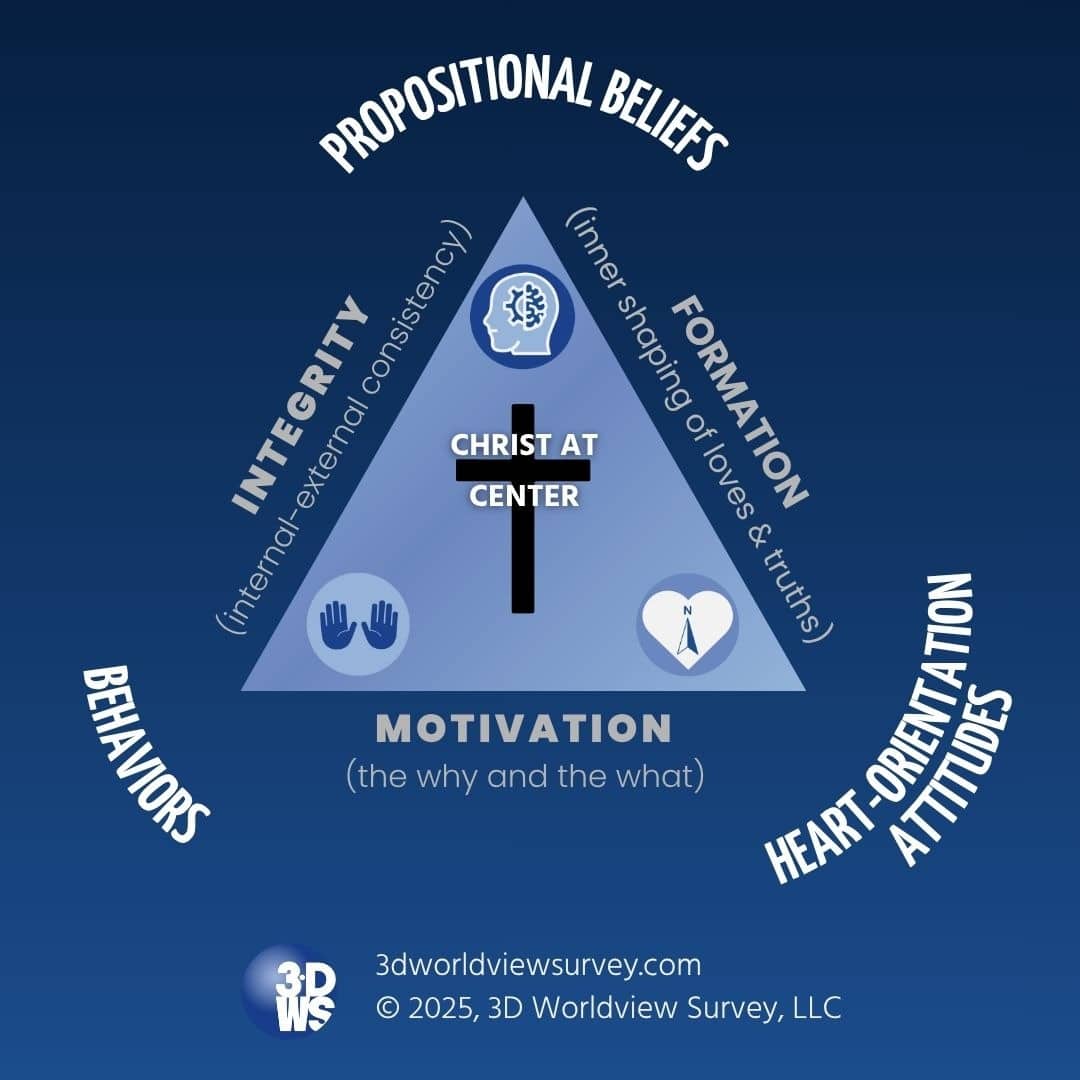
The 3-D worldview framework recognizes three distinct but interconnected dimensions: beliefs, behaviors, and heart orientation. Each influences the others.
A student’s beliefs can shape both attitudes and actions. Behaviors can reinforce or weaken beliefs and desires over time. Heart orientation—the attitudes, affections, motivations, and desires of the heart—can influence both what students embrace as true and how they choose to live.
This means that what appears to be a simple belief-behavior gap may actually reflect deeper patterns across all three dimensions.
Worldview formation cannot be reduced to knowledge acquisition or behavior management alone. Instead, it requires attention to the interconnected dimensions of beliefs, behaviors, and heart orientation. To understand what is truly taking root, leaders must consider those three dimensions of worldview together.
Why Heart Orientation Matters
This third dimension is often the least visible.
Most schools have ways to assess knowledge. Behavioral expectations are also relatively easy to observe.
Heart orientation is different.
Students may affirm biblical truth and display generally appropriate behavior while quietly developing affections, desires, and loyalties that pull them away from Christ.
Conversely, students may struggle behaviorally while genuinely wrestling toward spiritual maturity.
This is why heart orientation deserves careful attention.
Worldview formation involves more than intellectual agreement with Christian truth. It also includes what students love, desire, trust, and ultimately worship. In many ways, their affections reveal what is most important to them.
Scripture consistently points to the heart as a central source of human action. Jesus taught that “the mouth speaks what the heart is full of” (Luke 6:45).
Why Observation Alone Has Limits
Experienced educators know their students well.
They notice patterns. They build relationships. They develop instincts.
Those strengths matter. Yet every Christian school leader faces the same limitation.
Some students are highly visible. Others are not.
Faculty members often hear from the most vocal students while receiving limited insight from quieter classmates. Likewise, compliant students may appear spiritually healthy even when significant worldview confusion exists beneath the surface.
Jesus warned that appearances can be misleading. He described people who honored God with their lips while their hearts remained far from Him (Matthew 15:8).
No Christian school leader wants to make assumptions about students.
Yet assumptions naturally fill the gap when evidence is unavailable.
As a result, conversations about discipleship often become subjective:
- “We think students understand this.”
- “They seem to be growing.”
- “My impression is that they’re doing well.”
Sometimes those impressions are accurate. Sometimes they are not.
Without meaningful data, leaders often struggle to distinguish between the two.
What Disconnects Often Reveal
When students say one thing and live another, the issue is not always hypocrisy.
- Sometimes it reflects confusion.
- Sometimes it reflects immaturity.
- Sometimes it reveals competing influences that have never been identified.
The apostle Paul described this tension when he wrote, “For I do not do the good I want to do, but the evil I do not want to do—this I keep on doing” (Romans 7:19).
Students face similar struggles.
They absorb messages from peers, media, culture, family systems, churches, and social networks. These influences can shape beliefs, behaviors, and heart orientation in complex ways.
Consequently, leaders should not merely ask: “What do our students believe?”
They should also ask:
- “How consistently do those beliefs appear in daily life?”
- “What attitudes, affections, or desires may be helping or hindering spiritual formation?”
Those questions move beyond information toward discipleship.
They help schools identify where targeted instruction, mentoring, discussion, and spiritual support may be most needed.
Clarity Supports Better Discipleship
Assessment does not replace discipleship. It strengthens it.
Teachers assess reading comprehension because they want students to grow. Coaches evaluate performance because they want athletes to improve. Likewise, Christian school leaders benefit from understanding where students currently stand.
When leaders can identify patterns, they gain greater confidence in curriculum decisions, Bible instruction, chapel themes, mentoring efforts, and faculty conversations.
Instead of relying entirely on observation and hope, they gain insight into what may actually be shaping students.
That kind of clarity allows schools to respond proactively rather than reactively.
It helps leaders address worldview gaps before students face the pressures of college, careers, and adulthood.
Students may learn to give the right answers or display the expected behaviors while deeper issues remain unaddressed. Lasting spiritual formation requires more than correcting outward actions. It involves addressing the deeper realities of the heart.
As Proverbs 27:23 advises, “Be sure you know the condition of your flocks.”
Faithful stewardship requires understanding what is happening within those entrusted to your care.
Key Takeaways
- Correct answers do not automatically indicate mature worldview formation.
- Students’ beliefs, behaviors, and heart orientation are distinct but interconnected dimensions that influence one another.
- What appears to be a simple belief-behavior gap may actually reflect deeper issues of heart orientation.
- Observation and intuition are valuable but limited tools for understanding student formation.
- Greater clarity helps Christian school leaders make wiser discipleship decisions.
Moving Beyond Assumptions
Most Christian schools are deeply committed to discipleship.
The question is rarely whether leaders care.
The question is whether they have enough visibility to know where formation is strong and where additional attention may be needed.
Students often say the right things.
The challenge is determining whether those truths have become part of how they live and who they are becoming.
The visible gap between belief and behavior is often the first thing leaders notice. Yet beliefs, behaviors, and heart orientation continuously influence one another. Understanding all three dimensions provides a clearer picture of what is actually taking root in students’ lives.
If this question resonates with you, I encourage you to download the free guide, “What Is Really Shaping Your Students?” It includes ten actual worldview questions designed to help Christian school leaders begin identifying areas where beliefs, behaviors, and heart orientation may not fully align.
Sometimes a few carefully chosen questions reveal more than we expect.